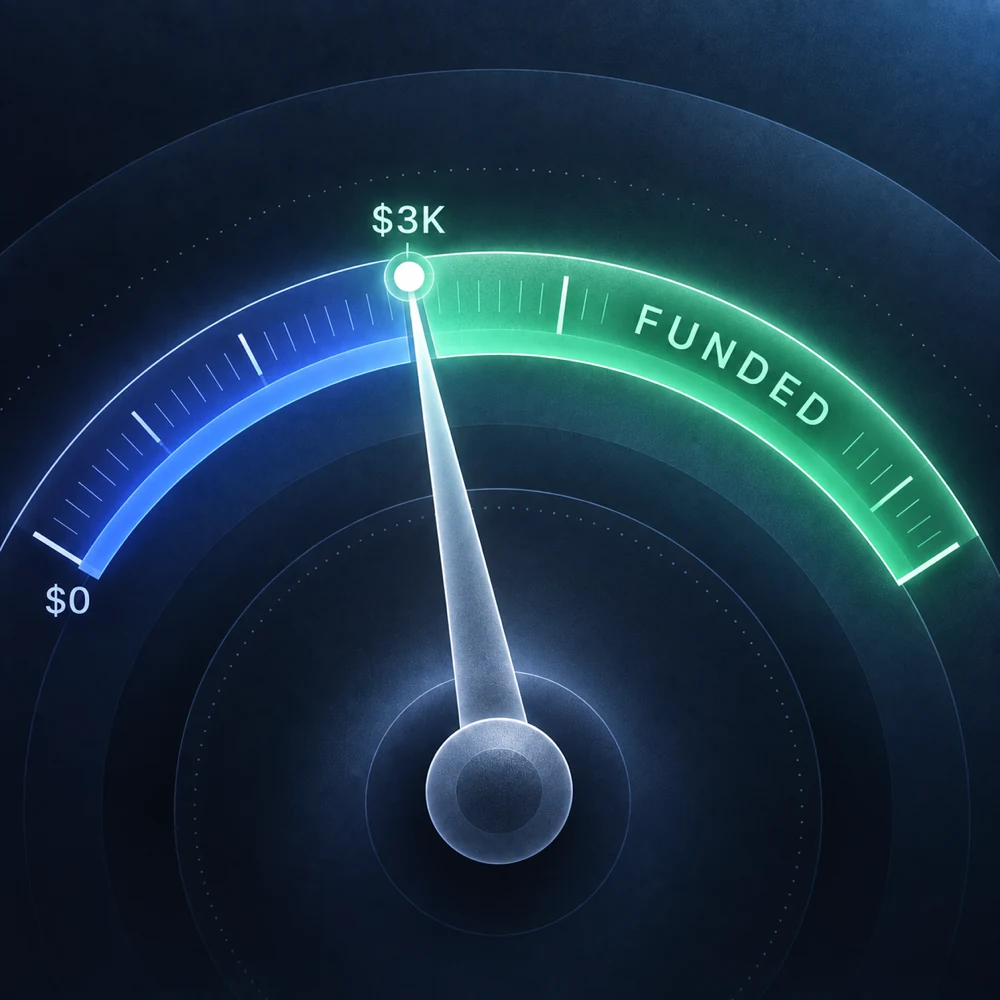
Hit the $3,000 target, and funded trading begins automatically.
You can pass in one day, or even just one trade. Spark rewards skill, not arbitrary schedules that make you ‘prove it.’
Meet Spark
With Spark you can trade 24/7 and pass in just one trade with rules so simple, you’ll think we’re lying.
Spark keeps the low fees and fast payouts traders love, but kills the punishing rule combos and profit caps they hate.
You can pass in one day, or even just one trade. Spark rewards skill, not arbitrary schedules that make you ‘prove it.’
Any trade on Spark can make up any percent of your target. Big wins don’t move the goalposts. You’ll never need to make even more to offset them.

Spark doesn’t force end-of-day close. Trade whenever the setup still works and keep positions open outside market hours.
Spark’s rules don’t change once you’re funded, so you can keep running the same strategy.
The $1,500 max-loss gap you managed in your eval stays exactly the same.

Taking a payout won’t move you closer to breach. Your balance, high-water mark, and floor all lower by the same amount.
Take payouts as often as you want, as soon as you’re funded, even same-day. If profit’s over $50, you can get paid on-demand.
There’s no buffer to build up or punishment for taking an early payout.
Spark has…
Hit $3,000 in profit (6%)...
Without dropping $1,500 below your high (3%)
Max loss is tracked as a trailing gap off your closed-balance high, updated daily at 00:30 UTC. Open trades never count against your high, only your max loss.
Spark does not have…
You can win in one trade or one day, using the strategy you’re used to.
Because most NQ and ES traders don’t even realize how badly they’ve been getting screwed right now.
It’s not just one rule, it’s how they stack up together to hurt you.
A quick example…
Consistency rules: Fine, industry standard.
Minimum trading days: Annoying, but OK.
But combined, they unleash a two-headed monster that keeps you from getting paid:
You can’t finish early (minimum days) and you can’t have a standout day (consistency rule) without accidentally raising your target permanently.
You’re stuck in a situation where skill is a liability and good instincts break the rules, forced to pace yourself with “OK” trades on a made-up schedule no matter what the market does.
(P.S. Spark has neither of these rules. Just trade well to pass. Refreshing, right?)
Get funded, and it gets even worse.
First, celebrate by paying an activation fee. Congrats! You’re officially a threat to their cashflow.
Then, their rules and limits get tighter. Relearn the game while you’re playing it, or breach trying.
Sometimes, open PnL counts against you: they breach you for being in ‘pretend profit’ before you’ve even closed. Or there’s a daily loss limit and a payout counts as a loss. Maybe a news event hits and gives them an easy way to disqualify your trade.
You can breach without even understanding why, and getting paid is just as confusing.
They might have a ‘profit buffer’ and a penalty if you withdraw before the time limit nobody mentioned outside the fine print.
If you do finally manage a payout, it eats into your room and can end your account.
Then they throw in a profit cap: jump through 83 flaming hoops, and your reward is a fixed upside of a few thousand bucks no matter how well you traded. Game over.
One profit target. One max loss limit. Trailing drawdown and a high-water mark based on closed balances. That’s it.
And when it’s time to get paid, there’s no cap, no buffer, and no “wait until next week,” because it’s on-demand, 24/7.
One target. One risk limit. One-time fee.
All 1,500 evaluations in this release have sold. Spark is closed for now.
Leave your name and email and we’ll tell you if more Spark evaluations are released.
Here’s how to size your trades:
To power 24/7 trading, Spark uses Hyperliquid products, not CME futures.
You size by equivalent notional exposure, not contract count.
Use the tool below to see notional exposure in contract terms:
Use the tool below to see notional exposure in contract terms:
Exposure comparison
Illustrative NQ reference: 29,570.75, September 8, 2026.
Equivalent notional only. Spark uses Hyperliquid index products, not CME futures. Contract equivalents change with market price. Spread, book impact and four-hour financing apply. Maximum exposure is not a recommended position size.
They hide the fine print. We blow it up so you can see Spark’s difference.
The $50,000 evaluation has a $3,000 profit target. At $53,000, the account upgrades automatically to funded trading, including on day one. There are no minimum trading days or consistency requirements.
The floor starts at $48,500, which is $1,500 below the initial $50,000 balance. Closed-balance highs raise the floor at 00:30 UTC. Open profits do not raise it, but equity, including open P&L and charged costs, is checked continuously against the active floor. The floor never locks, and Spark has no separate daily loss limit.
The same $1,500 maximum-loss gap, leverage limits and stated account size apply in the evaluation and funded stages. There is no activation fee. The standard profit split is 80/20, with an optional 90/10 upgrade at checkout.
No. Spark provides leverage trading through Breakout Terminal. ES and NQ examples compare notional exposure only. They do not imply CME execution, identical margin requirements or identical trading costs.
Yes. Spark allows news trading without blackout windows and supports 24/7 trading without a forced end-of-day close. Financing still applies to held positions.
For XYZ100, SP500, Gold, Silver and Oil, commission is 0.04 basis points per side. That is $4 for a $500,000 round trip, before spread and book impact. Financing is 0.013% per day, billed in six four-hour intervals. Crypto commission is 4 basis points per side.
Payout access starts on day one of funded trading. All positions must be closed, and the minimum is $50 after the profit split. There is no payout buffer, cap, consistency gate or qualifying-day requirement. Day-one eligibility does not promise same-day processing.
This release is limited to 1,500 evaluations. Once all 1,500 sell, Spark will no longer be available to purchase. A failed evaluation has no reset option; another attempt requires a new purchase while Spark is available.
One target. One risk limit. One-time fee. Hit $3,000 and funded trading starts automatically.
Breakout’s evaluation program is intentionally rigorous and designed to verify a trader’s risk-management skill and strategy discipline before any proprietary capital is allocated. Most applicants do not pass on their first attempt and there is no guarantee that your performance will improve or that you will pass any future evaluations. Prospective traders should purchase an evaluation only if they are confident in their trading ability and accept the risk of not qualifying for a funded account. Evaluation fees are non-refundable for each attempt once trading begins, regardless of outcome.
If you pass the evaluation phase and become a funded trader (“FT”) with POL, all market-facing transactions, if any, are carried out exclusively by POL, for POL’s own principal account and at its sole discretion. FTs do not own any trading account or position, and hold no beneficial or proprietary interest in POL’s accounts, assets or trades. When an FT submits a trade idea, POL may, in its absolute discretion, either (i) record the idea as an internal, administrative book entry and calculate a hypothetical result without routing any order externally, or (ii) accept the idea for POL’s proprietary book and route the transaction to a market maker or exchange. FTs have no control over, or visibility into, the method POL selects.
POL may receive financial incentives from third parties based on trade ideas provided by FTs. Any such revenue is retained solely by POL and is not shared with FTs. Because such financial incentives are not included in PnL for FTs, conflicts of interest may exist between POL and each FT. FTs should carefully consider these conflicts before participating. In addition, because Breakout earns fees each time an evaluation trader fails and then re-purchases an evaluation, conflicts of interest may also exist between Breakout and each evaluation trader.